


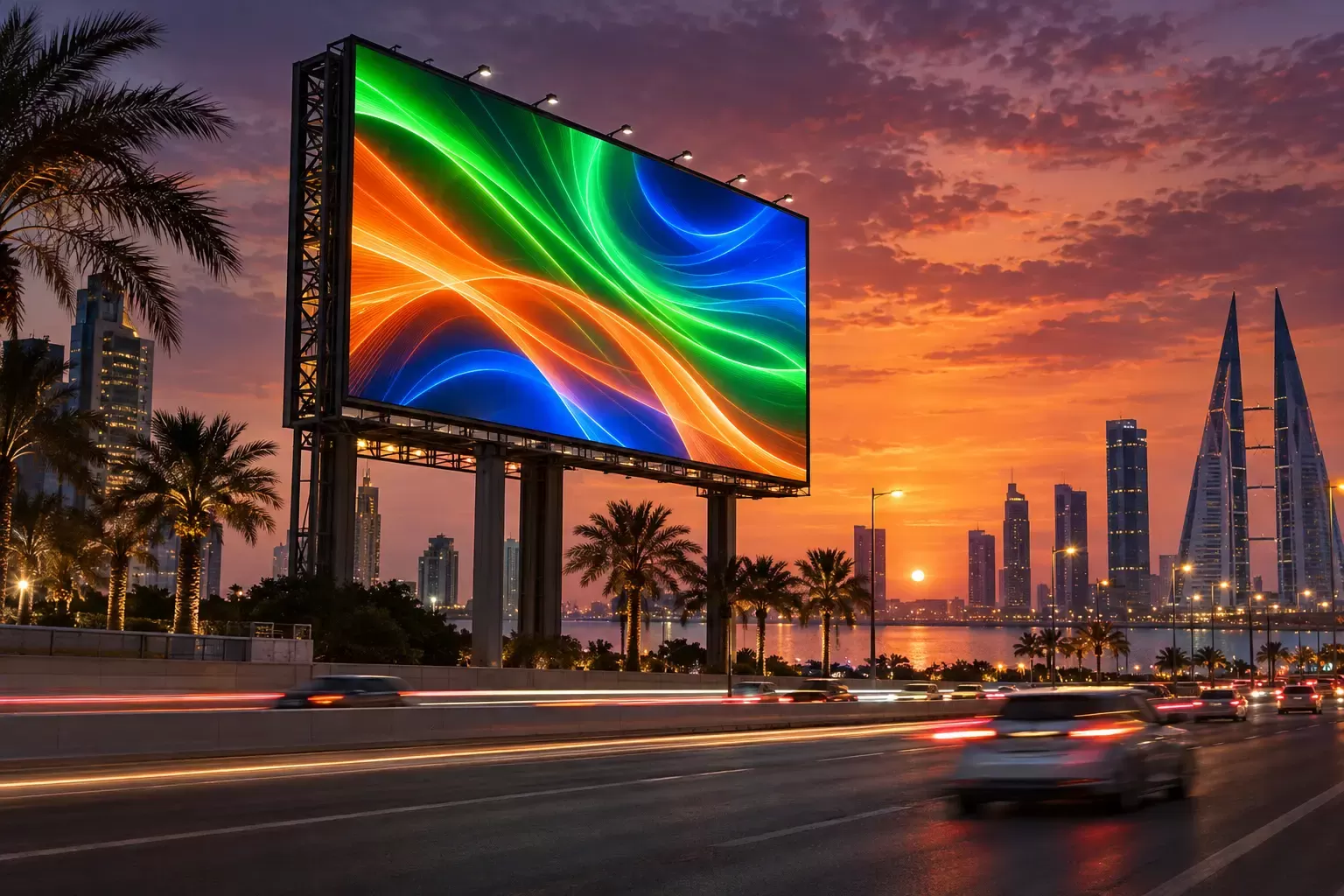
Sooner or later, most businesses in Bahrain end up asking the same question: should we put in a digital screen, and if so, what kind? The answer isn't as straightforward as picking whatever looks best in a showroom, because LED and LCD screens are genuinely built for different jobs — and the wrong choice usually shows up later, either as a screen that's unreadable in direct sunlight or one that cost far more than the space actually needed.
Here's a practical breakdown to help you figure out which one actually fits your situation.
The Basic Difference
LCD screens work the way a standard TV or computer monitor does — a liquid crystal display panel with a backlight behind it, all sealed as one unit with a fixed resolution and screen size.
LED screens are built from individual LED modules or panels, tiled together to create a display of virtually any size and shape. Instead of one sealed panel, you're looking at a wall made up of many small light-emitting diodes working together.
That difference in construction is really what drives everything else — brightness, cost, flexibility, and where each one actually makes sense.
Where LCD Makes More Sense
Indoor spaces with controlled lighting. Offices, reception areas, retail counters, meeting rooms — anywhere the screen isn't fighting against direct sunlight. LCD panels produce sharp, high-resolution images and are the more cost-effective option for standard indoor use.
Smaller, close-viewing setups. If people will be standing or sitting relatively close to the screen — a menu board, a product display, an information kiosk — LCD's pixel density gives you crisp detail at close range without needing an oversized LED wall to achieve the same clarity.
Budget-conscious single-screen installs. For a single reception screen or a small retail display, LCD is almost always the more economical choice. You're paying for a standard panel size rather than a custom-built modular wall.
Video walls built from multiple LCD panels. For larger indoor displays, several LCD screens can be tiled together into a video wall — a common approach for control rooms, retail feature walls, or lobby displays that need to be bigger than a single panel but don't need LED-level scale.
Where LED Makes More Sense
Outdoor and semi-outdoor installations. This is really where LED's biggest advantage shows up in Bahrain specifically — LED screens are built to produce far higher brightness levels, which is what's actually needed to stay visible under direct Gulf sunlight. An LCD screen outdoors, even a bright one, tends to wash out and become unreadable during the day.
Large-scale displays. Anything approaching billboard size, or large video walls for exhibition stands and events, is realistically an LED job. LCD doesn't scale to that size without stacking multiple panels and dealing with visible bezel lines between them; LED panels tile together with minimal to no visible seams.
Exhibition stands and event production. LED walls have become close to a standard feature at trade shows and corporate exhibitions — the same kind of vertical LED integration we used on the recent NITI exhibition stand build. They're modular, can be configured into different shapes and sizes for different booths, and hold up to being assembled and disassembled repeatedly across events.
Long viewing distances. Anywhere people are viewing the screen from a distance — a large retail storefront, a stadium-style setup, or a big venue — LED's brightness and scale make it far more effective than trying to achieve the same visibility with LCD.
A Straightforward Way to Decide
Ask two questions:
Where is the screen going? Indoors under normal lighting → LCD is usually the better value. Outdoors, or anywhere with strong ambient or direct sunlight → LED is close to a requirement, not just a preference.
How big does it need to be, and from how far away will people view it? Small to mid-size, viewed up close → LCD. Large-format, viewed from a distance → LED.
If your answers point in different directions for different parts of the same project — say, an indoor reception screen plus an outdoor storefront display — that's normal. Many businesses in Bahrain end up using both: LCD indoors where it's more cost-effective, and LED outdoors or for larger-format needs where it's genuinely the only practical option.
Cost Considerations Worth Knowing Upfront
LED installations generally cost more per square meter than LCD, largely because of the modular panel construction and the mounting/structural work involved, especially for outdoor installs that need weatherproofing and secure mounting against wind loads — a real factor for Bahrain's coastal conditions.
That said, comparing cost purely per screen misses the point. An LCD screen that isn't visible in daylight isn't actually doing its job outdoors, regardless of how much cheaper it was upfront. The right comparison is cost against the specific use case, not cost in isolation.
Making the Right Call for Your Space
The businesses that end up happiest with their digital screen investment are usually the ones who nailed down the use case before choosing the technology — where it's going, who's viewing it, from what distance, and under what lighting conditions. Working backward from those answers makes the LED-vs-LCD decision much clearer than starting from a generic comparison.
If you're planning a digital screen installation — whether it's a single reception display or a full LED wall for an exhibition stand or storefront — Techno Graphics can assess your space and recommend the right fit. Get in touch for a free consultation for your business in Bahrain.